Green wedding: why a sustainable outdoor wedding needs one thing above all: shared experiences
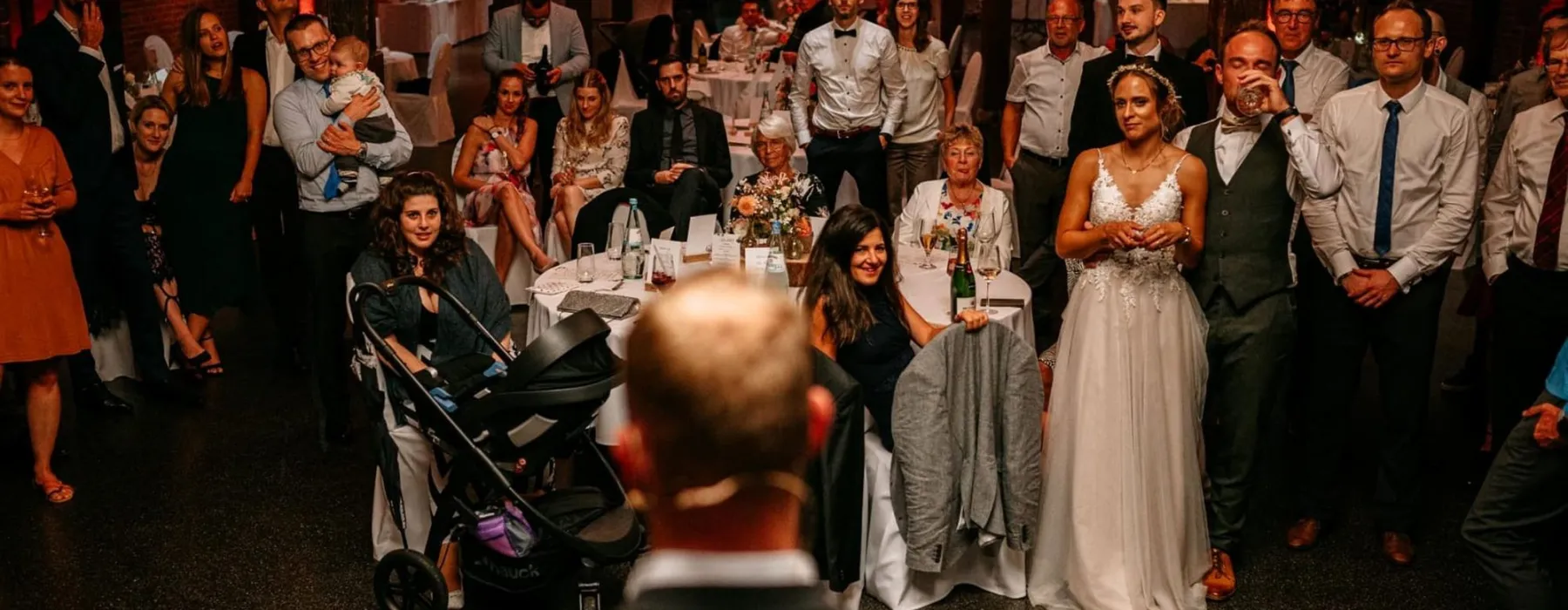
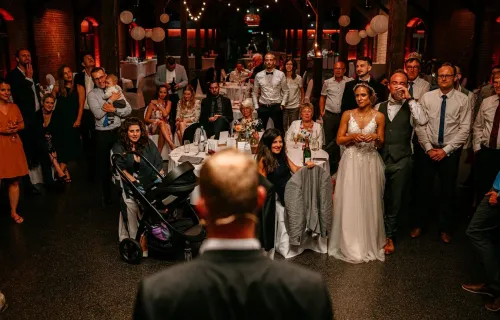
People who marry today marry more deliberately. Less show, more substance, more nature. I have performed as a magician at weddings for more than 15 …
A green wedding is one where the couple deliberately bases its decisions on sustainability: regional instead of flown in, seasonal instead of arbitrary, borrowed instead of bought once, close to nature instead of elaborately staged. Doing without is rarely the point. The question is where resources really make a difference and where they don't.
In the German-speaking countries a whole scene has grown around this idea. The platform SimplyMarried.net connects couples who want to marry close to nature and with intention with matching venues and suppliers: from organic catering and regional florists to open-air humanist ceremonies. Their motto: “Personal instead of pompous, sustainable instead of arbitrary.”
The recycled invitation card is a nice touch, but it isn't the lever. Anyone who wants to reduce a wedding's environmental impact has to start with three big items.
1. Guest travel and accommodation. In the common wedding footprint calculators, guest mobility is the single largest item, often well over half of the CO₂ footprint depending on guest numbers and distances. The frequently quoted benchmark of around 14.5 tonnes of CO₂ equivalent for an average wedding comes from the UK market (Sustainable Wedding Alliance, based on a footprint calculator). It is an order of magnitude, not a measurement. But it shows why venue and guest list are the decisive levers.
2. Food and drink. Regional, seasonal cooking with less meat noticeably lowers the balance. At a winery or a country inn it tastes better than any flown-in menu anyway.
3. The number of guests itself. Every guest brings travel, a plate, a chair and decoration. The tiny wedding trend is therefore not just a question of style but the most effective sustainability measure of all.
Behind these come the smaller levers that organisations such as BUND and magazines such as Schrot&Korn list: regional flowers, rented rather than bought decoration, second-hand or hired outfits, rings made from recycled gold, digital invitations.
Some context: according to the German Federal Statistical Office, around 348,800 marriages were concluded in Germany in 2025, the lowest figure since the time series began in 1950. People marry less often, but more deliberately. That is exactly the gap the green wedding fills.
The outdoor wedding is the natural setting for a green wedding. An orchard meadow, a winery, a manor farm or a barn need hardly any additional decoration; the landscape is the stage set. Holding ceremony and reception in one place also saves transfers, which is precisely the largest item from point 1.
What couples underestimate when planning an outdoor wedding, in my experience:
Now the point that hardly any green wedding guide mentions: the most sustainable investment at a wedding is not an object but an experience.
That isn't a magician's romance; it is well researched. Consumer psychology has shown for years that experiences raise satisfaction longer and more strongly than material purchases (Van Boven & Gilovich, Journal of Personality and Social Psychology, 2003). Experiences shared with others are also perceived more intensely than the same experiences alone; Boothby, Clark and Bargh described this in Psychological Science in 2014 under the title “Shared Experiences Are Amplified”. And wonder in particular makes people more social and more generous: Piff and colleagues showed in 2015 that awe makes the self smaller and the willingness to behave prosocially larger.
There is now dedicated research on magic. A review by Bagienski and Kuhn (International Journal of Wellbeing, 2019) describes how experiencing magic triggers curiosity, wonder and social connection. Wiseman and Watt showed in a controlled study with 200 participants (PeerJ, 2024) that even a short magic trick markedly increases surprise, curiosity and excitement, with large effect sizes. The study found no effect on long-term life satisfaction; in fairness, that belongs here too. For a wedding day the short-term effect is all you need. It is about the hours in which strangers become a party.
Translated to your wedding: a wedding favour usually ends up in a drawer. The moment when the aunt from Kiel and the college friend from Munich stare together at a signed card that has just appeared inside a sealed wine bottle stays. And the two of them keep talking until dessert.
I held the checklist up against my own programme. It fits better than I first thought:
If you want to marry sustainably, ask every supplier the same questions. That applies to catering and florists just as much as to photography and entertainment:
The last question is the most important. Guests remember neither the colour of the napkins nor the label on the favour. They remember how they felt.
How much does a green wedding cost compared with a conventional one?
Often less. The biggest sustainability levers save money at the same time: a smaller guest list, one venue for ceremony and reception, nature instead of decoration, renting instead of buying. Usually only organic catering and fair-trade rings cost more.
Does magic work at an outdoor wedding without electricity?
Yes. Close-up magic needs neither power nor a stage nor technology. For an evening stage show I bring a battery-powered PA.
When should we book entertainment for the wedding?
For summer dates between May and September I recommend booking firmly five to six months in advance. More in the article Create unforgettable moments at your wedding with a magician.
Where do we find sustainable suppliers and venues?
SimplyMarried.net lists venues and suppliers in Germany, Austria and Switzerland that specialise in green weddings, filterable by criteria such as “no power required” or “mobile and compact”.
Planning a green wedding or outdoor wedding in Rhine-Main, Rhine-Neckar or the Palatinate? Then write to me with the date, venue and approximate number of guests via the contact form. More about my programmes: Close-up & Walking Act and Magic at private parties.
People who marry today marry more deliberately. Less show, more substance, more nature. I have performed as a magician at weddings for more than 15 …
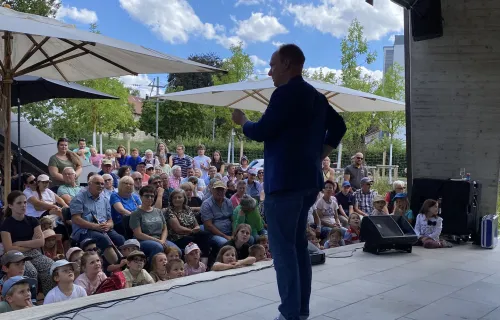
In 2015 I stepped onto a garden show stage in Baden-Württemberg for the first time, in Mühlacker. In Ellwangen this summer the crowd was so large …
Ellwangen
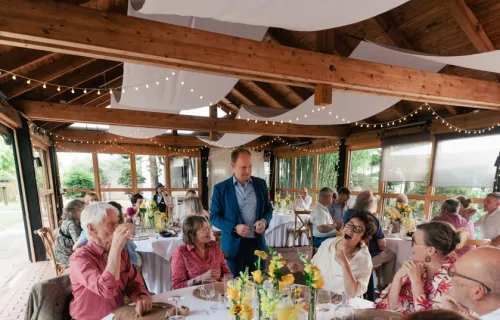
Some performances need no stage. At a milestone birthday at the Bonsai Zentrum Heidelberg, I moved right among the guests, at the tables and during …
Bonsai Zentrum Heidelberg
